How to Play Sudoku: A Step-by-Step Guide for Beginners
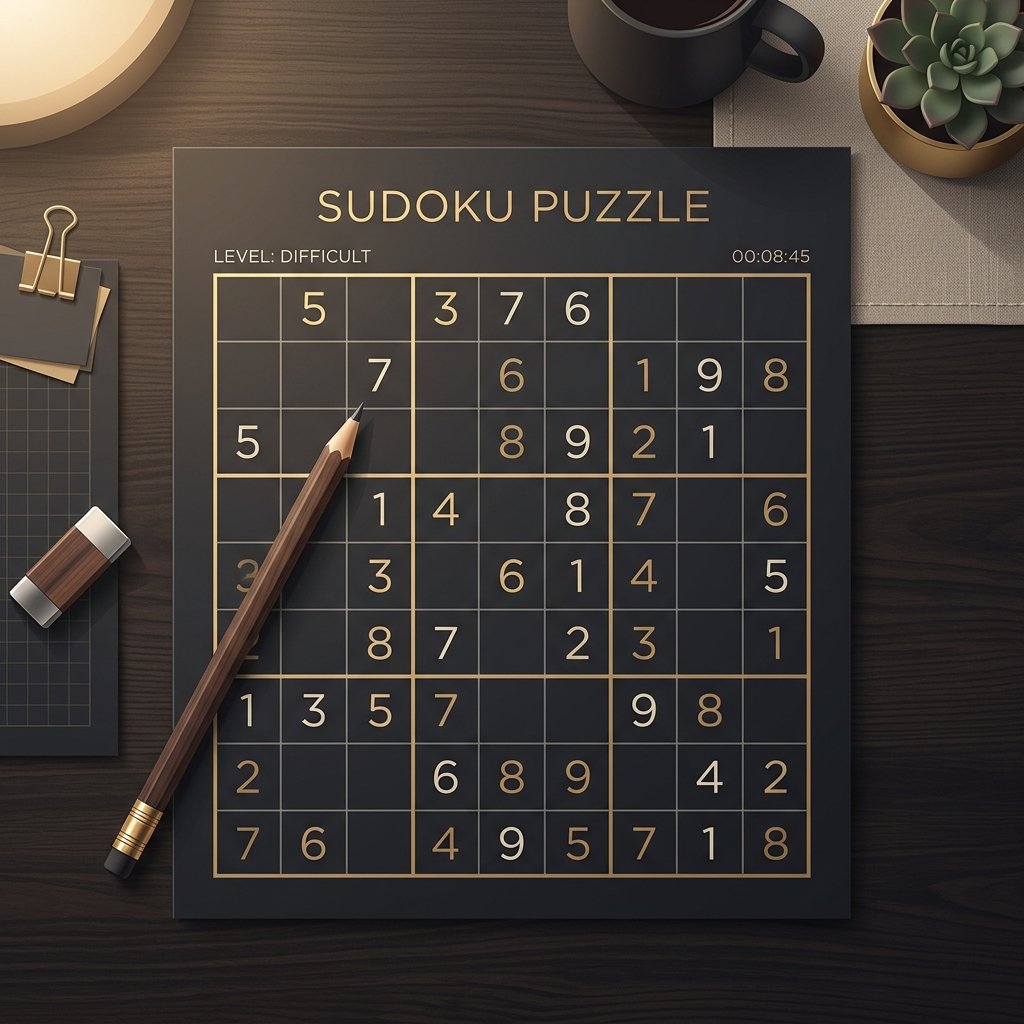
Sudoku is one of the most popular logic-based puzzle games in the world, played by millions of people daily. The word Sudoku is short for Sūji wa dokushin ni kagiru in Japanese, which translates to "the digits must remain single." Despite the grid consisting of numbers, solving a Sudoku puzzle requires no math calculations whatsoever; it is solved purely through logical elimination and visual deduction. This makes it an ideal workout for memory, focus, and deductive reasoning.
If you have ever stared blankly at a 9x9 grid wondering where to start, this step-by-step guide is for you. We will break down the essential rules, explain the layout of the grid, and provide a simple strategy roadmap to get you solving puzzles in minutes.
1. The Sudoku Grid Layout
A standard Sudoku puzzle consists of a grid containing 81 cells, arranged in 9 rows and 9 columns. This grid is further sub-divided into nine 3x3 boxes (often called "blocks" or "regions").
When you start a new game, some cells already contain numbers. These are called clues (or given numbers). The difficulty of the game depends on how many clues are provided and how they are arranged. Your goal is to fill the remaining empty cells.
Think of the grid as a coordinates map. We refer to rows from top to bottom as Row 1 (R1) to Row 9 (R9), and columns from left to right as Column 1 (C1) to Column 9 (C9). Each cell is identified by its row and column (e.g., R3C4 is the cell in Row 3, Column 4).
2. The Three Simple Rules of Sudoku
To solve a Sudoku puzzle, you must fill the grid so that every number from 1 to 9 appears exactly once in three different scopes:
- Every Row: Each horizontal row of 9 cells must contain all numbers from 1 to 9, without repetition.
- Every Column: Each vertical column of 9 cells must contain all numbers from 1 to 9, without repetition.
- Every 3x3 Box: Each of the nine 3x3 blocks must contain all numbers from 1 to 9, without repetition.
Because these rules are absolute, each valid Sudoku puzzle has exactly one unique solution. No guessing is ever required; if you place a number based on a guess, you risk breaking the rules of the board later on.
3. Basic Strategies for Beginners
Strategy A: Cross-Hatching (Grid Scanning)
The easiest way to begin is by scanning rows and columns to eliminate locations for a specific number within a single 3x3 block. This is called Cross-Hatching.
Suppose you want to place the number "5" in the top-left 3x3 block (Block 1). Look at the neighboring blocks. If Row 2 already contains a "5" in another block, and Row 3 also contains a "5" in another block, you can draw imaginary horizontal lines through Row 2 and Row 3. This tells you that the "5" in Block 1 cannot go in Row 2 or Row 3. Now, if Column 2 already contains a "5," draw a vertical line through Column 2. Often, this intersecting grid of exclusions leaves only one single empty cell in Block 1 where a "5" can fit. That is your solve!
Strategy B: Counting Missing Numbers (Sole Candidate)
Look at rows, columns, or 3x3 boxes that are already mostly filled. If a row only has two empty cells remaining, count which numbers are missing from 1 to 9. If the missing numbers are "3" and "7", check the columns intersecting those two empty cells.
If the column intersecting the first empty cell already has a "3," then by rule, a "3" cannot be placed in that cell. Therefore, the first cell must be "7", and the second cell must be "3." This is called finding the Sole Candidate.
Strategy C: Use Pencil Marks (Notes)
As the difficulty increases, you won't be able to solve every cell in your head. This is where Notes (pencil marks) come in. Toggling the pencil icon allows you to write candidate numbers in the corners of cells. For example, if a cell could be either a "4" or a "9", write both. As you eliminate possibilities elsewhere in the row or column, you can erase candidate numbers until only one remains.
4. Step-by-Step Solve Walkthrough
Let's simulate a standard opening solve sequence to see how these strategies work in real-time:
- Step 1: Find the High-Frequency Numbers. Look at the grid and count which number appears the most as a clue. If the number "7" appears six times across the board, scan the rows and columns containing those "7"s. You will quickly find the remaining three "7"s using simple cross-hatching.
- Step 2: Clean Up Simple Rows. Look for any row or column with 7 or 8 cells filled. If a column has the numbers 1, 2, 3, 4, 6, 7, 8, 9, the missing number is obviously 5. Fill it in immediately.
- Step 3: Track Intersecting Blocks. When looking at a 3x3 box, if you see that a candidate can only go in R2C1 or R2C2, you don't know which one yet. However, you do know that the candidate must lie in Row 2 of Block 1. Therefore, you can safely eliminate that number as a candidate for Row 2 in Block 2 and Block 3! This is an intermediate technique known as Locked Candidates.
Summary & Practice
Sudoku is a fantastic exercise for your brain. By starting with scanning and slowly learning to cross-reference rows and columns, you can quickly build the deduction skills needed for Hard and Expert puzzles. Try starting with an Easy game on our home page to practice these techniques!