How to Play Solitaire: Step-by-Step Beginner Guide
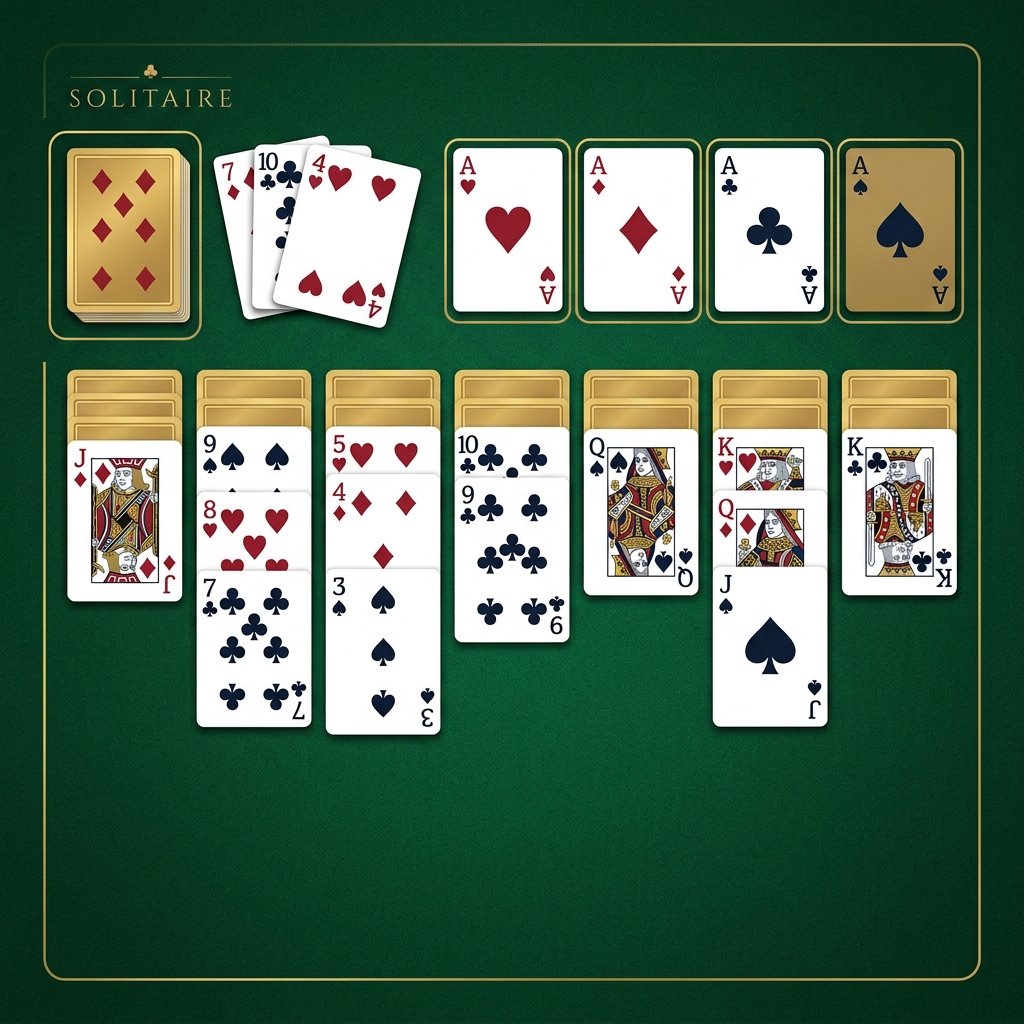
Klondike Solitaire is the most popular classic card game in the world. Often referred to simply as "Solitaire," it is a single-player game played with a standard 52-card deck. Solving a Solitaire puzzle requires planning, visual scanning, and logical sequences. Play it on our site with custom options like Draw-1 and Draw-3!
This comprehensive beginner's guide explains the game board, standard movement rules, and core strategic tips to help you solve your first Solitaire layout successfully.
1. The Solitaire Board Layout
A standard Solitaire game is arranged into four key regions on the board:
- The Tableau: The seven columns that make up the main play area. The columns contain cards stacked vertically, with the bottom card face up. The first column has 1 card, the second has 2, up to the seventh column which has 7 cards.
- The Stock (Draw Pile): The face-down pile in the top-left corner. These cards are drawn when you have no moves left on the Tableau.
- The Waste Pile: The face-up pile next to the Stock. This hosts the cards that have been drawn from the Stock and are available to play.
- The Foundations: The four empty cells in the top-right corner. This is where you compile card suites starting from Ace up to King.
2. Core Movement and Build Rules
To move and stack cards on the board, you must follow three strict rules:
- Alternating Colors: You can only stack cards on the Tableau by placing a card of the opposite color on top. For example, a red Jack can only be placed on a black Queen (Spades or Clubs).
- Descending Order: Cards on the Tableau must be stacked in descending order (King is high, Ace is low). Example: `K -> Q -> J -> 10 -> 9 -> ... -> 2`.
- Foundations are Suit-Specific: The four foundations must start with an **Ace** of a specific suit (e.g. Ace of Hearts). You build them in ascending order of the same suit (`A -> 2 -> 3 -> ... -> Q -> K`).
If a Tableau column becomes completely empty, only a **King** (or a stack starting with a King) can be moved into that empty slot.
3. Standard Step-by-Step Play
To play a game of Solitaire:
- Scan the face-up cards on the Tableau. Move any Aces to the Foundations.
- Build stacks on the Tableau using the descending alternating-color rule (e.g. placing a Red 9 on a Black 10).
- When you move a card and expose a face-down card underneath, click it to flip it face up. Exposing face-down cards is a top priority!
- When no moves are available, click the Stock pile to draw cards to the Waste pile.
4. Top Strategies for Solitaire Beginners
Tip A: Reveal Face-Down Cards First
Always prioritize moves that expose face-down cards in the Tableau. Opening these cards gives you more moves and prevents piles from being locked.
Tip B: Don't Empty Columns Without a King
Avoid clearing a Tableau column completely unless you have a King ready to fill the slot. An empty slot is useless without a King, and clearing it prematurely restricts your options.
Tip C: Play from the Tableau First
If you have a choice between moving a card from the Tableau or the Waste pile, choose the Tableau. Cards in the Tableau block other face-down cards, while Waste cards can be cycled again.
Summary
Solitaire is a relaxing game of logic. By exposing face-down cards, building foundations, and managing empty slots with Kings, you will solve layouts in no time! Try a game on our home page now!